Tool Helps Analysts Estimate Labor Costs for Substance Use Disorder Interventions
Costing tool matches common staff positions involved in SUD treatment interventions with national wage data.
A new costing tool from the CHERISH Methodology Core helps analysts calculate labor costs for staffing positions commonly found in substance use disorder (SUD), hepatitis C virus (HCV), HIV, and behavioral health treatment interventions. Developed by Don Lochana Ekanayake, senior research associate at the University of Miami Miller School of Medicine, the labor cost calculator aims to standardize the approach for analysts to value staff time, whether measured in hours or in a percentage full-time equivalent, and collect data on staff roles and wages.
Labor costs are often the most expensive component of an intervention, accounting for nearly half of intervention costs, or more, in some economic studies. Yet, staff-related activities, such as time spent on recurring meetings or ongoing coordination, are often overlooked in financial or budgetary documentation. In some cases, salary data is not available, or the analyses requires estimating labor costs using national wage estimates to ensure that wages are consistent across sites. Moreover, cross-walking staff positions to occupational data can be complex and influence the choice of appropriate wages.
What the Labor Cost Calculator Does
To help analysts properly measure staff time, the labor costs calculator matches common staff roles that support SUD interventions to the Occupational Information Network (O*NET), a national wage database of U.S.-based occupations. Using data from NIH-funded trials of interventions to prevent or treat SUDs, the matching process helps analysts perform microcosting analyses that can be compared and generalized across interventions. Analysts can use the tool to:
1. Estimate salaries.
The Labor Cost Calculator worksheet calculates the total compensation with benefits for common positions that are involved in delivering a SUD intervention.

2. See common roles that support an intervention.
The Occupation Menu includes an overview of titled positions, organized by academic/research, administrative, community, criminal-legal, and healthcare settings, and how they can be mapped onto O*NET. Additionally, in ambiguous cases, analysts can refer to the Alternative O*NET Role section of the menu to map the titled position to the most appropriate O*NET match.
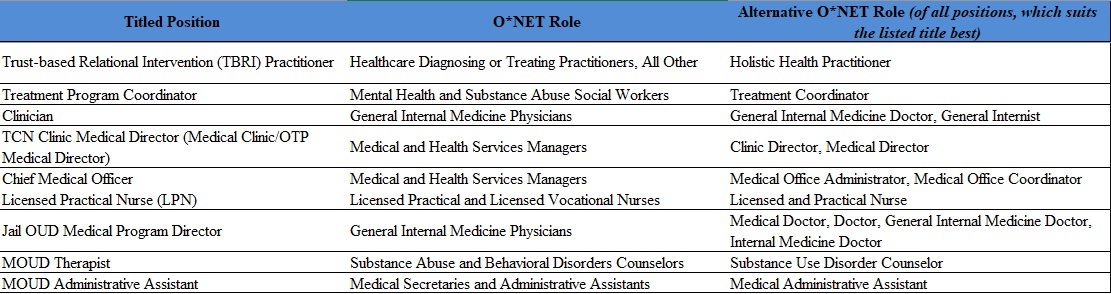
For example, a SUD treatment provider may have “MOUD Therapist” position listed on their expenditure report. With a careful review of credentials, average years of experience, and specific job duties, the tool maps this staff member to "Substance Abuse and Behavioral Disorders Counselors" or "Substance Use Disorder Counselors" as a representative occupation.
3. Match titles to national wage data.
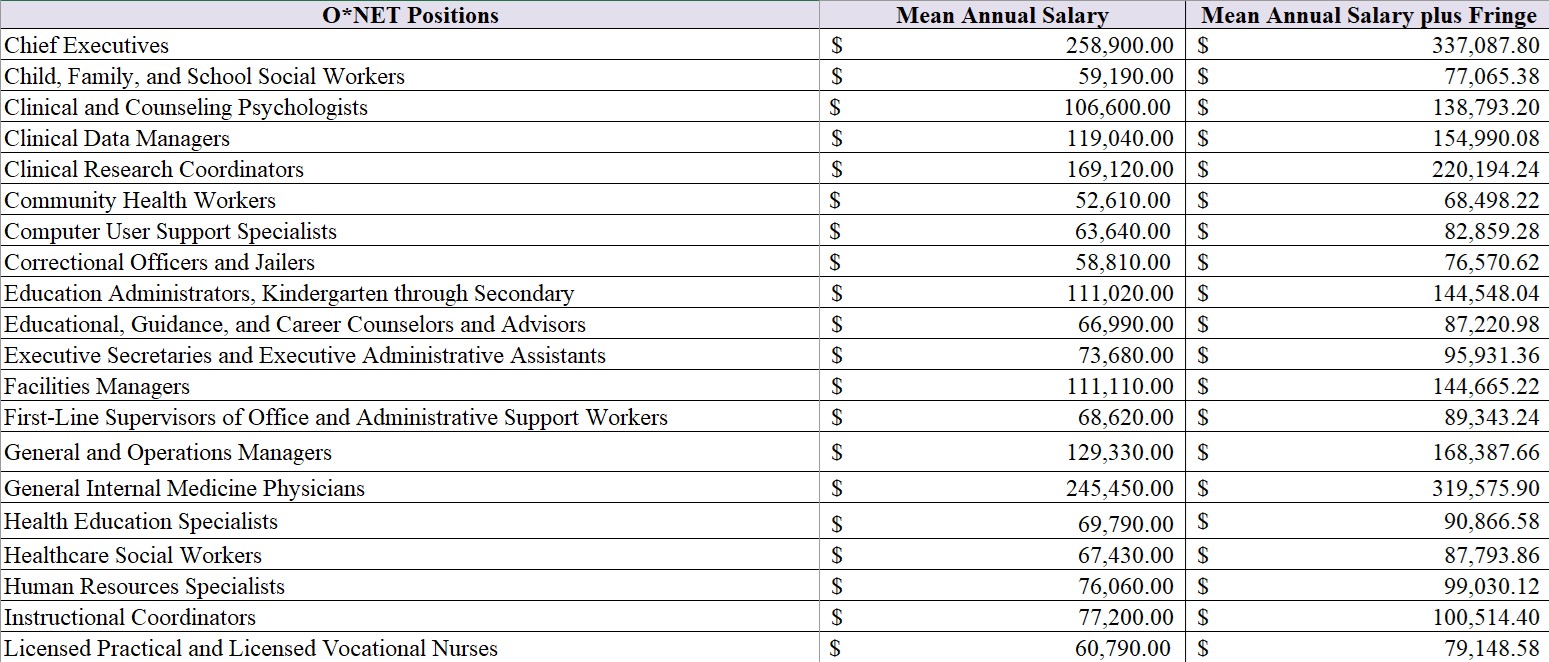
In the ONET Positions tab, analysts can view a table of O*NET positions and the affiliated salary and fringe benefit rate based on 2023 and 2024 reports from the Bureau Labor Statistics and O*NET. The data in this tab feeds into the Labor Cost Calculator.
Getting Started
Estimating Labor Costs of Interventions Targeting Substance Use Disorder and Other Conditions
Download the labor cost calculator
In the following tutorials, users can learn how to estimate the labor costs or salary of a project manager. In the final dashboard, additional salary estimates are automatically calculated and can be integrated into a separate budget impact tool to determine overall labor costs. To request additional support on how to use the labor cost calculator for an economic evaluation, connect with the CHERISH Consultation Service or submit a general inquiry.
A poster presentation of this tool titled, “Labor Cost Calculator for Assessing Staffing Costs: Application in Interagency Partnerships to Tackle Substance Use Disorders (SUDs),” will take place at the Addiction Health Services Research (AHSR) 2026 conference in Salt Lake City, Utah.